


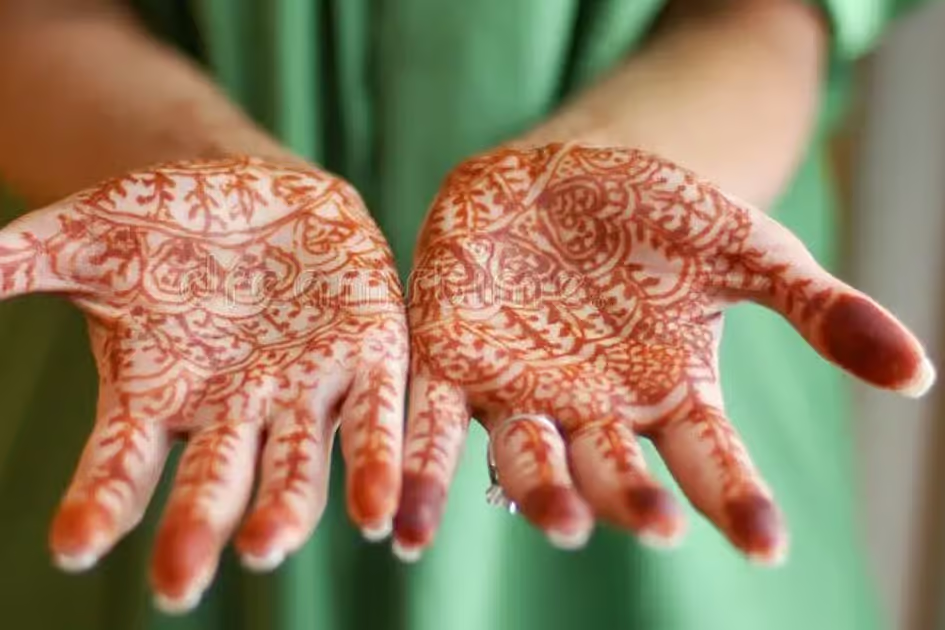
The henna design on a seven-year-old should have faded in days. Instead, it left a second-degree burn on her skin, and a white scar her dark skin will carry for the rest of her life.
The case is one of many seen by Dr Salem Antabi, a specialist dermatologist with over 30 years of clinical experience, who has been treating UAE children for henna-related skin injuries throughout his career. As families across the country prepare for Eid Al Adha, he is urging parents to think carefully before painting any henna on a child’s skin.
“I am completely against henna for children from one to three years old,” he says. “It can cause skin irritation, redness, allergic reactions. And if the child puts their hand in their mouth, the body can absorb it. It can poison them.”
Stay up to date with the latest news. Follow KT on WhatsApp channels.
The doctor pointed out that, in particular, “black henna is completely forbidden, for children and adults alike. It contains highly toxic substances. It can cause burns.”
‘Left a white scar that never went away’
According to Dr Antabi, pure natural henna produces a reddish-brown stain and carries a lower risk than its darker variants. The greatest chemical danger, he explains, comes from what is added to make the colour darker, blacker or longer-lasting: paraphenylenediamine, or PPD, a substance approved internationally only for use in hair dyes, never for direct application to the skin.
But natural henna is not safe for children either, he warns. A child’s skin behaves differently to an adult’s.
“A child’s skin is thinner, more absorbent, and reacts faster and more severely to any substance applied on it,” Dr Antabi says. “Some of the worst cases I have seen were not from black henna. They were from ordinary, natural henna applied to a young child’s skin.”
He recalled one case in detail.
“I had a child come to me with blisters. A second-degree burn from henna,” he says. “We treated it like a burn. And it left a scar. It left a white mark that never went away.”
The most common complaints he sees in children remain redness, irritation, and itching. But the worst cases, he warns, escalate far beyond that.
“Even the so-called ‘mild’ or ‘natural’ varieties, I am against them for children. They can still contain substances that cause skin burns, allergic reactions and irritation. After the inflammation, comes pigmentation; children’s skin are so sensitive that breakouts and bumps can follow for weeks.”
‘Don’t know what materials are being used’
Eid celebrations have also introduced a newer trend: airbrushed and painted-on “temporary tattoos” set up at children’s parties and shopping malls.
“You see these children everywhere now, getting designs painted on their faces,” Dr Antabi says. His deeper concern is what parents cannot see.
“We don’t know what materials are being used. The substances must be approved and regulated by the Ministry of Health. The colours must be monitored. Not whatever the artists at the mall happen to use.”
Dr Antabi says that if a child must have a design at all, it should be with surface-level paint that can be wiped off easily, and it should never be applied on the face.
What parents can do this Eid
Dr Antabi’s practical guidance for families is straightforward:
-
Avoid black henna entirely, for children and adults alike.
-
Avoid all henna for children from one to three years old. Their skin is still developing and absorbs substances faster than an adult’s.
-
Before applying any henna or temporary tattoo, do a patch test. Place a small dot on the child’s inner forearm and wait at least 20 minutes. If any redness or irritation appears, do not apply.
-
If the test passes, start small. A single finger, not a full hand. A small design, not the elaborate patterns used on adults.
-
Only use henna and tattoo pigments that are approved and regulated by health authorities.
-
Wash off any temporary tattoo immediately when the child gets home. Do not let it sit overnight.
-
Watch for warning signs in the days after: redness, itching, raised skin, blisters, or any discolouration spreading beyond the design. See a dermatologist immediately if these appear.
“Eid should leave behind memories,” Dr Antabi says. “Not scars on a child’s skin.”
Source: Khaleej Times