


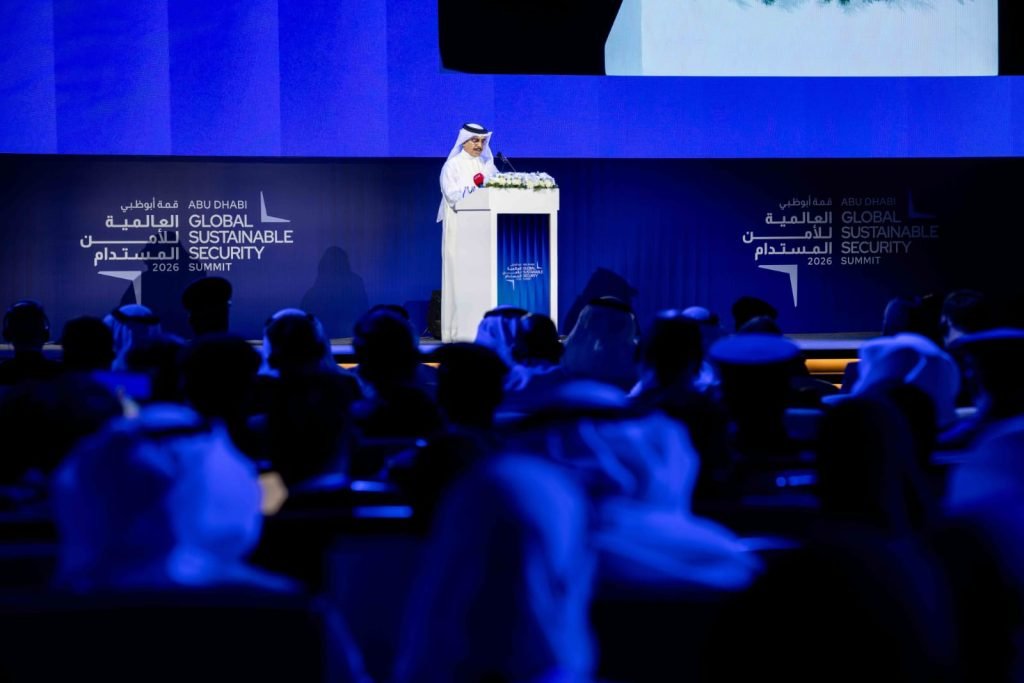
ABU DHABI, 21st May, 2026 (WAM) — – Under the patronage of Lieutenant General H.H. Sheikh Saif bin Zayed Al Nahyan, Deputy Prime Minister and Minister of Interior, the Abu Dhabi Global Sustainable Security Summit (ADGSSS) concluded its inaugural edition at ADNEC Centre Abu Dhabi, having convened from 19 to 21 May 2026.
The Summit was organised by the Ministry of Interior and Rabdan Academy in collaboration with ADNEC Group, Summit served as a strategic platform bringing together leaders, experts, and decision-makers from around the world to discuss the future of security, resilience, and sustainability.
The closing day’s proceedings opened with remarks by Ohood bint Khalfan Al Roumi, Minister of State for Government Development and Future, who stated: “The world today is witnessing accelerating change, led by geopolitical and security challenges that have become among the most influential factors affecting the stability of economies, supply chains, and global energy. Crises are no longer confined within national borders or to traditional conflict zones, but have extended to ports, maritime corridors, trade flows, energy markets, food and medicine supplies, vital technologies, and even the digital space.”
She added: “Readiness, proactivity, and the seizing of opportunities is an approach established by the founding fathers, and our wise leadership today continues along the same path, viewing preparedness for the future as a necessity, a strategic choice, and a major responsibility. Thanks to the visionary and prudent foresight of our wise leadership, the UAE was among the first governments to integrate the future as a core component within the government’s structure, establishing a dedicated future department within every government entity. The UAE has transformed readiness into a working model and daily practice, as it seeks to achieve a balanced and integrated approach to preparing for tomorrow.”
Major General Dr. Ahmed Nasser Al Raisi, Inspector General at the Ministry of Interior and Chairman of the Supreme Organising Committee for ISNR 2026, stated: “We are not living today through merely a passing period of disruption, but rather a phase of reshaping the entire global order, a world in which variables accelerate, and cross-border challenges grow ever greater. In the midst of this complex landscape, security threats are no longer traditional or clearly defined as they once were.”
“The United Arab Emirates has presented an exceptional model for how security can be managed during crises without affecting societal stability, the economy, or public trust. Today, when we speak of security and stability in the UAE, we are not speaking of slogans, but of tangible outcomes and global rankings.
According to the latest Global Safety Index data for 2026, the UAE ranked first globally as the world’s safest country, ahead of more than 140 countries. Abu Dhabi has also maintained its position as the world’s safest city for the tenth consecutive year since 2017, while Dubai features among the world’s highest-ranking cities in security and quality of life indicators,” Al Raisi added.
“The UAE’s emirates continue to consolidate a unique global model that combines sustainable security with quality of life, driven by a visionary leadership that has made the country’s cities a safe, advanced, and inspiring environment for the future. Security in the UAE is not merely the protection of borders, but the protection of a way of life, the protection of trust, and the protection of the psychological, social, and economic stability of society.
For this reason, and despite regional and global challenges, our country has continued to achieve strong and sustainable economic growth, maintaining the efficiency of its government institutions and the continuity of its services at the highest levels even in the most challenging circumstances. This was no coincidence, but the result of visionary leadership and long-term investment in building resilient, effective, and crisis-capable institutions,” Al Raisi concluded.
The Main Theatre hosted the closing panel discussion titled Resilience by Design: Capacity, Talent, and Institutional Preparedness, which examined how nations can systematically develop the human capital and institutional structures required to sustain long-term security readiness.
The Circles of Resilience Pavilion hosted the third and final Circle of Resilience session, in which His Excellency Major General Dr. Jasem Mohamed Al Marzouqi, Commander-in-Chief of Civil Defence, addressed institutional preparedness and civil protection in an in-depth discussion moderated by Hissa Hamed Mohammed Butti Al Hamed, Student at Rabdan Academy.
The final day’s programme also included three concurrent workshop tracks: the Student Research and Innovation Showcase, which highlighted emerging talent from within Rabdan Academy and the wider academic community; Integrated Governance: Coordinating Institutions, Regulation, and Risk; and Applied AI Solutions for Security, Policing, and Civil Protection.
Source: Emirates News Agency